 Lantern Street
Original sleep story
A Rainy Evening at the Bookshop
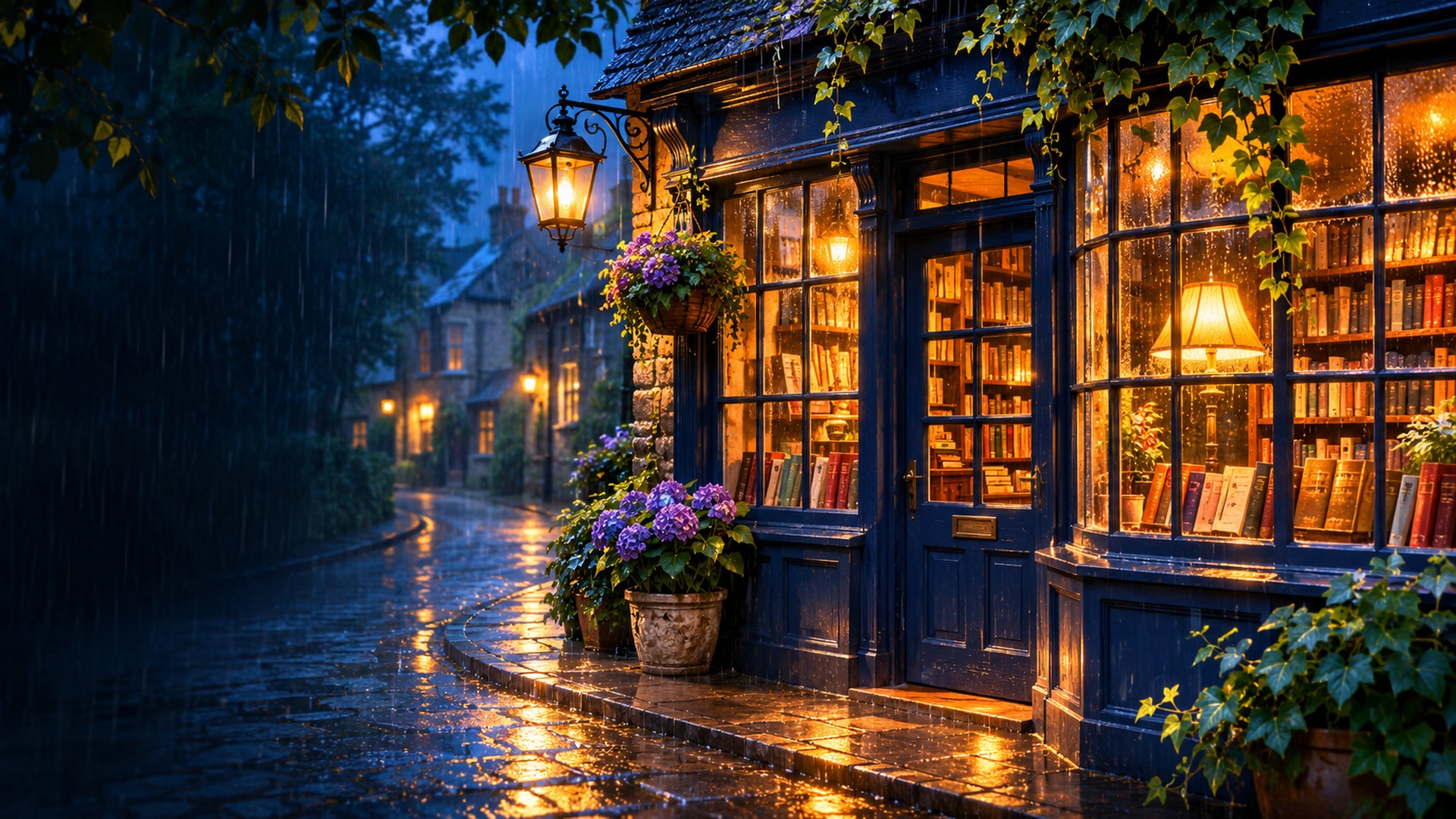
A rainy lane, a welcoming bookshop, and a letter left for an evening just like this. Settle beside the fire while Eleanor, Arthur and Nora share tea, cinnamon rolls, and a small kindness.
Your place is saved on this browser while you listen.
Know someone who could use a little quiet? Copy a story link and a short note to send them.
Watch on YouTube ↗ · Listen on Spotify ↗ · Listen on Pocket Casts ↗ · Listen on Apple Podcasts ↗
Characters: Eleanor Finch, the bookseller; Arthur Bell, retired railway clerk; Nora, the baker; Walter Finch, Eleanor’s grandfather. Gentle narration and rain; no music or sponsor messages inserted in this recording.
Read the complete story transcript
Welcome to Lantern Street. It is an autumn evening, and the rain has been falling since the middle of the afternoon. It is not hard rain, and it is not hurried. It falls steadily, the way rain falls when it has nowhere else to be. It runs along the slate roofs and gathers in the iron gutters, and from there it drops in thin silver threads to the pavement below. The cobblestones shine like the backs of small dark fish. Every few steps, a puddle holds a little piece of the street: a window, a doorway, the amber glow of a streetlamp trembling in the ripples.
The air smells of wet stone and fallen leaves. Along the curb, the maples have shed their reds and golds, and the rain has pressed them flat against the ground so that the whole lane looks as though it has been laid with a patterned carpet. Somewhere, a gutter gurgles. Somewhere farther off, a bicycle bell rings once and fades into the hush The shopkeepers have drawn in their awnings, and most of the shutters have been closed against the damp. But near the gentle bend in the lane, one window is still glowing.
It is a soft, honey-colored light, and it spills across the wet cobblestones in a long, warm rectangle, as if someone had laid out a welcome mat made of lamplight. Anyone walking past would slow down without quite knowing why. Anyone with a damp collar and cold fingers would feel the quiet pull of it. So let us step toward that window together, out of the rain, and see what waits inside. There is no hurry at all. The evening is long, and the lane will keep. The shop is called The Lantern and Leaf.
The name is painted in careful gold letters across a dark green board above the door, and beneath the lettering hangs a small iron lantern that sways a little whenever the wind passes. The building itself is older than most of its neighbors. Long before it held books, it held paper of another kind. It was the stationery shop of a man named Walter Finch, who sold fountain pens, bottles of ink, writing pads, and blotting paper to the people of Lantern Street for more than forty years. He was the grandfather of the woman who runs the shop now.
His name still appears, very faintly, in the old brass plate beside the door, polished smooth by decades of passing thumbs. The door is green, a deep mossy green, the color of a garden after rain, and its paint has softened at the edges where hands have pushed it open for years. A little brass bell hangs above it on a curl of spring steel. When the door opens, the bell gives a small, bright note, not loud enough to startle anyone, only loud enough to say that someone has arrived.
Tonight, the door is closed against the weather, and the glass in its upper half has clouded gently with warmth from within. Through the cloud, the lamps look like soft golden moons. A brass handle waits at just the right height. Beneath it, a worn stone step has been hollowed very slightly in the middle by all the feet that have crossed it. The rain patters on the little awning, a quick, friendly rhythm. And now the handle turns, the bell sings its small note, and the warmth of the shop comes out to meet us like an old friend holding open an arm.
Inside, the first thing you notice is the warmth. It settles over your shoulders like a folded blanket. The second thing you notice is the smell. Old paper, beeswax polish, a trace of wood smoke, and beneath it all, the faint sweetness of the tea that is always somewhere nearby. The ceiling is low and crossed with dark beams, and from those beams hang the lamps. There are six of them, each with a shade of cream glass, and each throws a small circle of gold onto the floorboards. The light does not glare.
It pools and it lingers, and it makes every spine on every shelf look like a row of quiet old friends. The shelves are old oak, dark and smooth, and they climb from the floor almost to the beams. They lean a little in the comfortable way of furniture that has carried heavy things for a very long time. A wooden ladder on brass rails rolls along the tallest wall. Books fill the shelves in no strict order except the order of affection. Novels beside poetry, atlases beside cookbooks, and little cloth-bound volumes tucked sideways into any gap that would take them.
In the back corner, on a square of slate tiles, stands the stove. It is a small black iron stove with a glass door and a short pipe that rises neatly through the wall. A low brass guard surrounds it, and a metal bucket of sand sits close by because Eleanor is a careful person and believes that warmth should always be kept safely. Behind the glass, the fire burns low and orange, a slow dance of small flames. It ticks and murmurs. A kettle rests on its flat top, beginning to whisper.
Near the stove sit two armchairs with worn green cushions, and between them, a little round table scarred by many cups. A rug of faded red and blue lies underfoot, soft with age. Everything in the room seems to have been chosen by someone who wanted visitors to stay a little longer than they planned. The proprietor is Eleanor Finch. She is a woman of middle years with silver threaded through her dark hair, which she keeps pinned up with a pencil. She wears a long gray cardigan with deep pockets, and her reading glasses hang from a cord about her neck.
She has run the shop for eleven years, ever since she inherited the building from her grandfather. She moves among the shelves slowly and without fuss, setting a book straight here, brushing a little dust away there, humming a tune with no particular name. The bell above the door gives its small, bright note. A gust of cool air slips in, carrying the scent of rain, and with it comes a tall, slightly stooped figure in a long navy raincoat. He pauses on the mat and shakes the drops from a black umbrella.
This is Arthur Bell. He is a retired railway clerk, seventy-one years old, with kind gray eyes and a neat white mustache. He wears a tweed cap, which he now removes with great courtesy, as though the shop were a church or a very good restaurant. "Good evening, Eleanor," he says. " Arthur," says Eleanor, and her face opens into a smile. " Come in, come in. You must be soaked." " Only a little," Arthur says. "The umbrella did its duty. It is the puddles that have been unkind to my shoes."
She takes his coat and hangs it on a hook near the stove, where it begins at once to steam gently. He sets the umbrella in the old brass stand by the door. For thirty years, Arthur stamped railway tickets at the town station, and he still carries himself with a clerk's neat precision. He wipes his shoes twice on the mat, glances at the floor to be sure he has left no puddle, and only then steps onto the rug. "The chair by the fire is free," Eleanor says.
" Then it is mine," says Arthur, and he settles into the armchair with the sigh of a man who has been walking all afternoon. He holds his hands toward the glass door of the stove and turns them slowly, warming the backs and then the palms. "I told myself I would only be a moment," he says. "I was on my way home, and I saw your window. I could not walk past." " Nobody can," Eleanor says. " That is the whole secret of the window." The kettle begins to sing.
Eleanor takes down three cups from a shelf, white cups with a thin blue line around the rim, and sets them on a tray beside a brown teapot. She spoons in the tea leaves, a fragrant, dark blend with a hint of orange peel, and pours the steaming water over them. The steam rises, curls, and drifts toward the lamps. The scent of the tea mixes with the wood smoke, and for a moment, the whole shop smells like the inside of a cozy memory. "Three cups," Arthur observes, looking at the tray.
" I am expecting someone," says Eleanor. "Though I never quite know when. The rain tends to bring her." Outside, a bright voice calls over the rain. The bell rings again, and in comes a rush of damp air with a little paper bag held aloft like a lantern. It is Nora from the bakery across the lane. She wears a flour-dusted apron under her yellow raincoat, and her brown curls have sprung loose from their scarf. She is carrying a small paper bakery bag folded at the top, and she kicks the door closed behind her with one foot.
"I have brought rolls," she announces, "and I have no regrets. It has been a slow evening at the bakery. The oven was still warm, and the cinnamon was calling." "Nora," says Arthur warmly, rising a little from his chair. "Please, stay seated, Mr. Bell," Nora says. "I am only the delivery." She sets the bag on the round table and opens the top. Inside, nestled on a sheet of waxed paper, lie two cinnamon rolls. They are large and golden, each one a spiral of soft dough shining with a glaze of sugar.
The scent rises like a small celebration: butter, cinnamon, warm sugar, and the faint toasted note of a good crust. Even the lamps seem to lean in. "Two rolls," Eleanor says, "and three of us." Eleanor fetches a small knife and three little plates painted with ivy leaves. Nora cuts the first roll carefully in thirds along the spiral, and the soft dough parts with a sigh. She cuts the second roll the same way. Six golden pieces rest on the waxed paper, each one fragrant and warm. She hands two to Arthur, two to Eleanor, and two to herself, laughing as she sets her own plate on her knee.
"Nora," Arthur says at last, "this is the finest roll I have eaten this year." " You said that last week," Nora says, grinning. "And it was true last week," Arthur says. "It is the sort of truth that renews itself." When the cups are empty, Eleanor pours more. The tea has deepened, rich and amber, and it fills the cups with a curl of steam. Nora tucks her feet under her stool. Arthur folds his hands over his waistcoat. The fire settles, shifting a log with a soft, glowing sigh, and the whole shop seems to breathe out with it.
After a while, Nora rises and brushes the crumbs from her apron. She wanders toward the shelves the way people do in a bookshop, with her head tilted and her fingers trailing lightly along the spines. She passes the poetry, the mysteries, the tall art books with their heavy covers. Near the bottom of the oak shelves, in a row of small cloth-bound volumes, she stops. One book has a pale blue cover, the soft color of a morning sky just after rain. She slides it out with two fingers.
"Oh," she says quietly. "This one is lovely." " I have never seen the sea in autumn," Nora says. " Not properly." " I think this book might let me." "It has been waiting for the right reader," says Eleanor, smiling. "It has been on that shelf for three years." " Then it has waited long enough," Nora says. She carries the pale blue book to the little oak counter, where a brass lamp glows beside an old cash register. Eleanor wraps it in a sheet of brown paper and ties it with green twine, tucking a small sprig of dried lavender beneath the knot.
Nora pays with a few coins and holds the parcel against her chest as though it were something warm. Arthur, meanwhile, has risen from his armchair and stands before the shelf marked Travel and Trains. He has a way of studying a bookshelf that is much like the way he once studied a timetable: slowly, carefully, with a finger that moves from line to line. Eventually, he lifts down a thick, handsome volume with a dark red cover and a title about the great railway stations of the world. "Ah," he says.
"Here is an old friend I have not met before." He turns the pages with great care. There are photographs of tall iron roofs, of clocks with Roman numerals, of long platforms where steam drifts like fog. He pauses on a picture of a station with a glass ceiling, where sunlight falls through the panes in long, bright bars. "I have stood in this very station," he says softly. "It was forty years ago. I remember the sound of the pigeons in the rafters and the smell of coffee from a little stall near the gate."
He closes the book gently, as if putting a memory back in its place. "I will take this one, Eleanor." " Of course," she says. He does not stop there. He walks to another shelf near the window, where the gardening books sit in a cheerful row. He hesitates and then selects a slim book with a green cloth cover, decorated with a pressed pattern of ferns and roses. "And this one," he says, " it is a gift. My sister loves her garden more than anything. She lives by the coast, and she writes to me every spring about her peonies.
I have never found the right present for her birthday, and I think this is it." " It is a beautiful book," says Eleanor. " The illustrations are painted by hand. She will love it. She will tell me everything in it is wrong," Arthur says with a fond smile, "and then she will read it three times." Eleanor wraps the two books together in brown paper and writes a little note on a card to go with the green one: "For a garden and for a sister." Arthur reads it and nods, his mustache lifting at the corners.
He counts out his coins with the exactness of a lifetime of ticket sales, and Eleanor rings them up on the old register, which gives a satisfying chime. The sound floats up toward the beams and fades among the lamplight. It is while Eleanor is tidying behind the counter that she notices the writing desk. It stands in the corner behind the counter, a small, dark, battered desk with a green leather top and a row of narrow drawers. It was her grandfather's. Walter Finch sat at that desk every day for forty years, writing receipts and letters and orders for ink in a tidy, slanting hand.
She has never moved it. Its leather has faded in the places where his elbows used to rest, and its brass handles have gone dark and soft. Tonight, as she reaches to straighten a pile of paper bags, her elbow brushes the desk, and one of the little drawers slides open an inch. It is a drawer she does not remember ever opening. Perhaps it was stuck for years, and the damp of the rainy evening has loosened it. She pulls it open gently. Inside lie a few pencil stubs, a pair of small brass scissors, a faded stick of red sealing wax, and, tucked at the very back, a cream-colored envelope.
The envelope is slightly yellowed at its edges. It has not been sealed with wax, only folded closed, and across the front, in her grandfather's unmistakable handwriting, are written the words, "For a rainy evening." Eleanor stands very still. The rain taps at the window. The fire murmurs. She lifts the envelope, and it weighs almost nothing in her hand. She turns it over once, then back, and runs her thumb across the familiar slanting letters. A small, warm feeling rises in her chest, like the feeling of hearing a favorite song from another room.
"Is something the matter?" asks Nora gently. "No," says Eleanor. "Nothing is the matter at all. I have found something of my grandfather's." She holds up the envelope so that they can see. It says, "For a rainy evening," and tonight, it is raining. Arthur and Nora exchange a glance, and a kind of soft hush settles over the shop. Nora sets down her parcel. Arthur removes his spectacles and polishes them with his handkerchief, and then puts them back on so that he will see clearly whatever comes next.
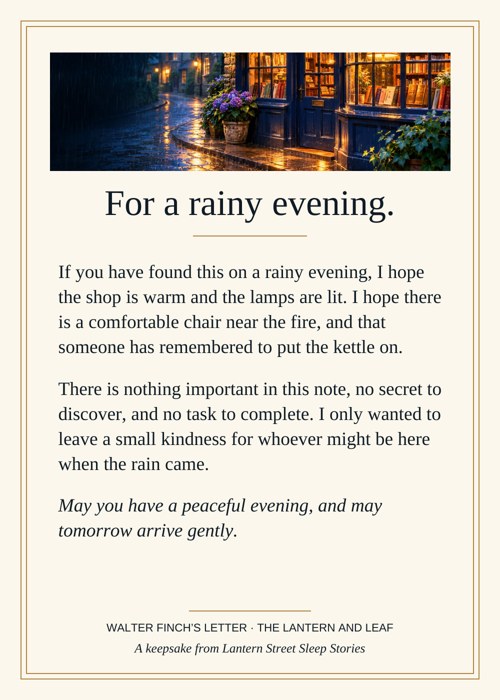
"Would you like to read it aloud?" Arthur asks. "Only if you wish, of course." Eleanor nods. She carries the envelope to the armchair by the fire, sits, and lifts the flap. Inside is a single sheet of cream paper, folded in thirds, the ink faded to a soft brown. She unfolds it. The paper crackles faintly. She puts on her reading glasses, and the lamplight catches the edges of the page, turning it to pale gold. Then, in her warm and steady voice, she begins to read. If you have found this on a rainy evening, I hope the shop is warm and the lamps are lit.
I hope there is a comfortable chair near the fire, and that someone has remembered to put the kettle on. There is nothing important in this note, no secret to discover, and no task to complete. I only wanted to leave a small kindness for whoever might be here when the rain came. May you have a peaceful evening, and may tomorrow arrive gently She finishes, and for a long moment, nobody speaks. The rain continues its soft patter on the roof. The stove ticks. A log settles into embers.
Eleanor lowers the letter to her lap, and her fingers rest lightly on the paper. "Well," Arthur says at last, very quietly, "the shop is warm." " And the lamps are lit," says Nora. " And there is a comfortable chair by the fire," Eleanor says, and she laughs softly with a little shine in her eyes. " And the kettle was on." " He must have written it long ago," Nora says, "on some other rainy evening maybe, and then tucked it away." "I think I will keep it on the desk," she says.
" Where he could see it if he were looking." " That seems right," Nora says. Slowly, the evening begins to turn toward night. The window has darkened from gray to deep blue, and the street lamps outside have bloomed into soft yellow halos. The rain has slowed, becoming a fine mist that drifts through the lamplight like powdered silver. The clock on the wall, an old round with a cream face, strikes a gentle eight. Arthur is the first to stir. He rises, settles his waistcoat, and takes his coat from the hook, warm now and smelling faintly of wood smoke.
"I must be getting home," he says. "Mr. Timetable will expect me at a respectable hour, and so will the kettle." He tucks the two wrapped books under his arm carefully, the way he once carried parcels of tickets. "Eleanor, thank you for the chair, the tea, and the letter." " The letter was my grandfather's doing," Eleanor says, " but I will pass your thanks along in my way." He puts on his tweed cap and lifts his umbrella from the brass stand. Nora gathers her own parcel, wrapped in brown paper and green twine, and her empty bakery bag.
She pulls her yellow raincoat around her shoulders and winds her scarf over her curls. " Good night, Mr. Bell," she says. " Mind the puddles." " I shall treat them with great respect," he says gravely, and the corners of his mustache lift. The door opens, and the bell gives its small, bright note. A breath of cool, damp air slips in, carrying the sweet smell of wet leaves and chimney smoke. The mist hangs in the lamplight outside. Arthur steps into it first, raising his umbrella with a soft snap.
Nora follows. They stand together for a moment under the little awning, watching the light play on the cobblestones. "Good night, Eleanor," they say, almost together. "Good night," she says from the doorway. "Walk gently." They walk away in opposite directions. Arthur's footsteps fade slowly down the lane, steady and unhurried, with the small click of his umbrella tip upon the stones. Nora's quick steps cross the street toward the bakery, where a single lamp glows above the door. For a little while, Eleanor stands and watches. Then the bell sounds, the door closes, and the warmth of the shop wraps around her once more.
Then she goes to the stove. This is the part of closing she is most careful about. She opens the glass door and looks at the embers, glowing deep orange beneath a soft gray ash. She spreads them gently with the iron poker so that they settle low and flat. She does not add another log. She checks that the brass guard is firmly in place around the stove, and that the bucket of sand stands ready beside it. She lays her palm near the glass, feeling the heat, which is gentle and steady.
The embers will burn down by themselves, safely behind their iron walls, and by midnight, they will be only a warm hush in the dark. She stands before the desk and rests her fingertips on the faded green leather. " Thank you," she says softly to the quiet room. "The shop was warm. The lamps were lit." Then she turns off the last lamp, and the room settles into a deep, soft darkness, lit only by the faint orange glow from the stove. She checks the front door, turning the key twice in the lock, and slides the iron bolt across.
She tests the latch of the window. She turns the little sign in the glass so that it reads closed, and the lantern outside still sways above it, a small gold light in the damp Then she takes the cream envelope from the desk and holds it close, walking to the narrow wooden staircase at the back of the shop. The stairs creak in familiar places, each step with its own gentle note. At the top is a small landing and a door painted a pale cream. Beyond it lies her apartment, a low room with a sloped ceiling, a faded blue sofa, a window seat piled with cushions, and a little kitchen with a window that looks out over the lane.
She sets her keys in a dish by the door and slips off her shoes. She puts the kettle on once more because her grandfather's letter asked it of her, and she finds that she wants to. While the water warms, she sits on the window seat and gazes down at Lantern Street. The envelope rests in her lap. She opens the window the width of a hand, and the sound of the rain drifts in, soft and fine and endless. The kettle sings in the little kitchen. Eleanor rises, makes a small cup of tea, and carries it back to the window seat.
She wraps her hands around the warm cup and breathes in the steam. She thinks of her grandfather sitting at his desk long ago, writing a few kind lines for a stranger he would never meet. She thinks of Arthur walking home with his railway stations and of Nora reading about a seaside village under a blanket. She thinks of the shop below, dark and safe with its embers glowing, its books resting on the old oak shelves, and its brass bell hanging quiet above the green door. She reads the letter one last time by the soft light of the window, and then she lets it rest against her heart.
The rain falls gently on the slate roofs and on the cobblestones and on the fallen leaves. The lantern burns softly above the green door. The lane is quiet, and the shop is warm, and every lamp that needed to be lit has been lit, and every kindness that needed to be given has found its way. Nothing is left undone. Nothing is waiting. And so the way her grandfather once wished for whoever might be there when the rain came, we wish it now for you. May you have a peaceful evening, and may tomorrow arrive gently.