 Lantern Street
Original sleep story
A Rainy Evening at the Bakery
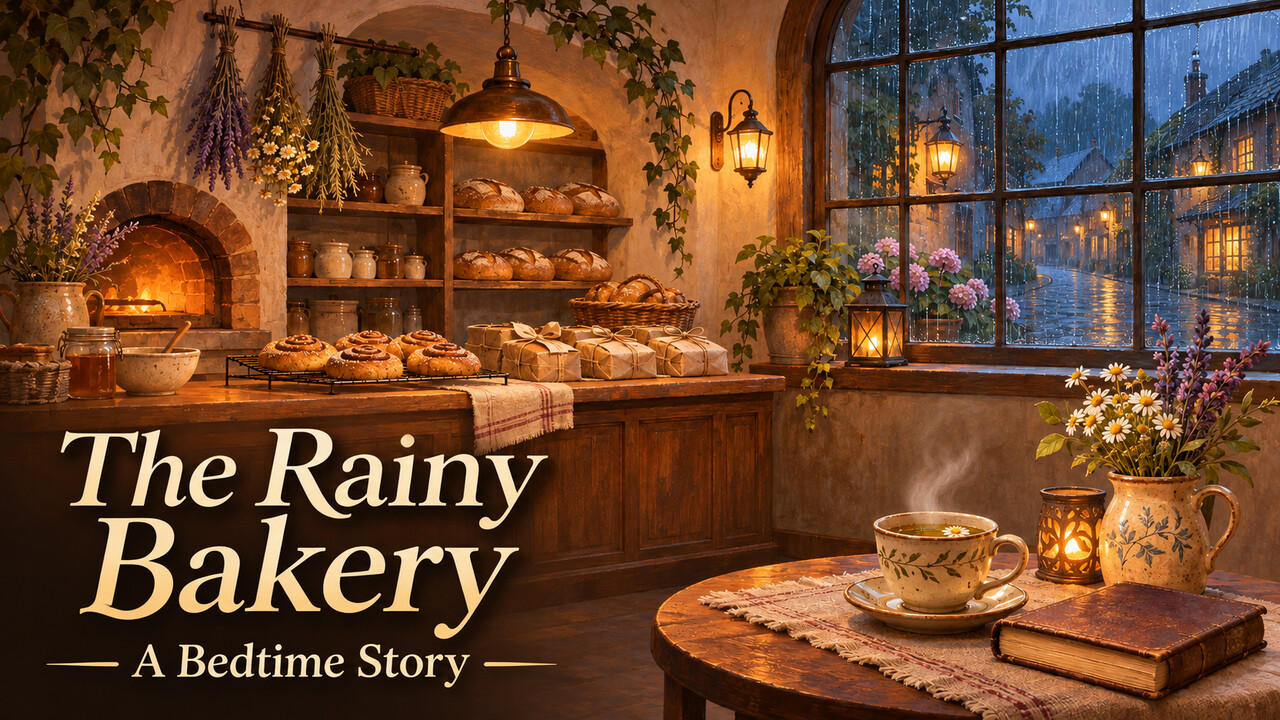
The shop has closed for the evening. Nora has herbal tea to steep, cinnamon bread to share, and a comfortable chair beside the window. Outside, rain keeps its own gentle rhythm.
Your place is saved on this browser while you listen.
Know someone who could use a little quiet? Copy a story link and a short note to send them.
Watch on YouTube ↗ · Listen on Spotify ↗ · Listen on Pocket Casts ↗ · Listen on Apple Podcasts ↗
Characters: Nora, the baker. Gentle narration and rain; no music or sponsor messages inserted in this recording.
Read the complete story transcript
Tonight, there is nothing you need to finish. You can leave the day just as it is, with a few things done and a few things waiting. There is a little bakery on Lantern Street where the lamps stay warm for a while after closing. We can stay there for a little while. Nothing complicated is going to happen. There will be a chair beside the window, a cup of herbal tea, and the last cinnamon loaf cooling on its rack. Nora, the baker, has already switched off the oven.
The busy part of her day is over. All that remains is a little putting away and then sitting down. You arrive while a fine rain is settling over the street. It darkens the pavement evenly, leaving the pale stones beneath the awning almost dry The bakery door is still open a little because Nora has seen you coming. She waves you inside with the folded towel in her hand. She has finished serving for the evening, she says, but she has certainly not finished having chairs. There is one here with no particular plans.
You step onto the mat and leave your umbrella in the wide pottery stand. A small puddle gathers beneath its tip, exactly where a puddle is allowed to gather. Inside, the room smells of baked flour, cinnamon, and the faint clean scent of a recently washed floor. There are cream walls and wooden shelves with a long counter worn smooth along its edge. Two amber lamps are enough for the whole front room. Beyond the glass, the rain makes the opposite buildings look softer, though they are the same familiar buildings they were this afternoon.
Nora pulls the door closed and turns the latch. The bakery is closed, and you are welcome. She lives in the rooms upstairs, and your room is upstairs, too, ready for your visit. Neither of you needs to go anywhere else tonight. She points out the hooks beside the door, then brings a dry cloth for your hands. Your coat can stay there until morning. The chair by the window has a broad seat and a cushion covered in faded green cotton. You ease into it while Nora sets a small saucepan of water on the little electric hob.
This is separate from the oven, which is dark and cooling at the back. She measures lemon balm and chamomile into a round teapot. There is no hurry in the measuring. A little leaf falls onto the tray, and she puts it in with the others rather than starting the world over for one stray leaf. While the water warms, she takes two cups from the shelf. Yours is cream with a blue line around the rim. Hers has the same line, except where the glaze wandered slightly before it was fired.
Nora likes that part. It makes the cups easy to tell apart without either one having to be important. She pours the water, switches off the hob, and sets the pot on a cork mat. The leaves need a few minutes. In the meantime, she moves the cinnamon loaf from the rack to a wooden board. Its crust has settled into small, gentle wrinkles. A narrow seam along the top shows where it rose. Nora cuts two slices with a steady hand, keeping the knife close to the board. The middle is still warm enough to soften a little butter, not warm enough to make you wait.
She puts a slice on a plate and slides it toward your chair on a little side table. The cinnamon runs through the crumb in an uneven brown ribbon. One end of your slice has more than the other. "This," she says, "is the bakery's very modest system of surprises." You take a bite from that end. The crust gives way easily, and the sweetness is quiet, with the plain taste of good bread beneath it. When she pours the tea, a little steam rises between the cups and disappears.
You hold yours by the handle and let the first sip be a small one. Nora sits on the counter stool for a moment with her own plate balanced on the tray. She asks whether the chair is comfortable, and you tell her it is. That settles the only question that needs settling just now. Outside, a bicycle goes slowly past beneath the streetlamps. Its rider is nearly home. Inside, a crumb lands on your plate, and Nora reaches for her slice. The rain carries on at the same even pace.
There are loaves on the far end of the counter, completely cool now and ready to wrap for tomorrow. Nora explains that they are for the early collection shelf. She baked them late this afternoon so they would have time to settle before being covered. The morning batch will be its own matter in the morning. These loaves already have everything they need. She brings over a stack of plain paper, a tin of short lengths of string, and a shallow basket. You can watch from your chair. She is not giving you a job.
She says this quite plainly because a visitor with warm tea ought not to be mistaken for spare staff. The first loaf is round with a little flower caught in the pattern on its top. Nora puts it in the middle of a sheet and brings the two sides together above it. The paper makes a soft, dry sound. She folds the seam twice, turns in the ends, and ties one length of string around the parcel. There is enough string for a small bow. Any longer would only give the bow ambitions.
She rests the finished loaf in the basket with its folded side facing up. Then she smooths the next sheet with her palm. You notice that she smooths from the center outward, the same way every time. The next loaf is longer and needs its paper turned the other way. Nora makes the adjustment without comment, as if this is an ordinary courtesy between bread and paper. Through the open end of the wrap, you can see the pale underside of the crust before she folds it closed. The kitchen clock moves on too softly to compete with the rain.
You lift your cup again. The tea is easier to drink now. Its warmth reaches your hands through the ceramic, and the lemon balm leaves a fresh, mild taste. There is plenty in the pot, but nothing requires you to finish what is already in your cup. One of the round loaves is a little smaller than the others. Nora sets it beside a jar of honey that was left for the neighbor who looks after the shared courtyard. They trade small things now and then, a jar, some apples, a loaf, never anything that needs an account book.
He brought in her empty baskets before the rain began, and tomorrow she will leave this parcel on his sheltered landing. She wraps it with the same care as the larger loaves. Then she puts the honey and the bread together in a handled basket. The kindness is ready. No errand needs doing tonight. When the last loaf is wrapped, she covers the basket with a clean linen cloth. The cloth has a narrow woven border that falls just above the counter. Under it, each parcel has its place without being pressed against the next Nora returns the unused paper to a drawer and puts the string tin beside it.
The lid fits with a gentle push. She brings her cup back to the tray and sits down for another minute. You both look at the basket, not because it needs inspection, but because a finished small task can be pleasant to look at. Tomorrow's bread is ready. Tonight's bread is here on your plates. After a while, Nora takes a wooden recipe box from the shelf behind the counter. Its corners are rounded by years of being picked up, and one side is lighter where it has faced the window.
She had left a few cards beside it earlier while choosing what to bake next week. They can go back now. The box is divided into plain sections with the everyday recipes near the front. She lays the loose cards in a neat fan. Some are covered in her own small handwriting. Others have wider letters and a different slant. There are little flower marks on more than one, though no flower was invited to help with the filing. She starts with the card for the simple seed loaf. The bottom corner has been folded and flattened so often that it bends more easily than the rest.
Nora slips it behind its neighbors, leaving enough room for the cards to move. Then comes the recipe for small oat biscuits. She rubs a thumb along the edge, loosening two cards that have caught together. You can hear the faint shuffle across the wooden counter. It is a practical, comfortable sound. The room asks for very little attention. You can follow each thing she does or let your gaze rest on the blue line around your cup. One card is a little smaller than the others. It holds the recipe for the cinnamon loaf you have been eating.
Nora knows the quantities without looking, but she still keeps the card. Her aunt wrote it at a kitchen table one wet autumn afternoon while Nora was visiting after school. The table had a drawer that always needed a small lift before it would close. Nora remembers that more clearly than anything grand. The lift of the drawer, a bowl with a chipped foot, and her aunt turning the loaf so the better side faced the plate. There had been no company coming. They simply liked setting it down that way.
Her aunt used to cut the loaf on a breadboard with one dark knot near the handle. Nora could tell where she was in the kitchen by the sound of that board being set down. Some afternoons, they ate at the table, and some afternoons, they stood beside the counter because the table was covered in sewing. The loaf tasted the same either way. Nora smiles at the card, not sadly, just with the pleasure of remembering something ordinary that had been good. She says she still turns a loaf toward its better side, though the difference is usually known only to the loaf Then she puts the card back in its place.
There is one blank card among the recipes. She holds it up, considers it, and returns it to the back of the box. Not every blank space needs an idea put into it. The thought seems especially reasonable tonight. She gathers the remaining cards, taps their bottom edges lightly against her palm, and files them in their sections. The lid comes down until it rests against the rim. A small recipe for another day can stay safely inside. You finish the last soft piece of your slice. The cinnamon taste lingers gently, and there is no need to remember any of the measurements.
At the sink, she washes the two plates in warm water. There are only two and the small bread knife, so the washing takes very little time. She rinses the knife with its blade turned away from her hand and places it flat on the drainer. The plates stand beside it. The cloth she uses for drying is striped cream and brown, almost the colors of the loaf itself. She dries each plate, turns it once to check the underside, and returns it to the shelf. There is no bright clatter, only the soft meeting of ceramic and wood.
The knife goes back into its drawer. The remaining cinnamon loaf is cool now. Nora covers the cut end and puts it in the bread tin for breakfast. The tin is broad and pale with a wooden lid that lifts off rather than hinges. There is room inside for the loaf without its touching either end. Tomorrow, a slice might be toasted, though tomorrow can make that decision for itself. She sets the tin beside the wrapped loaves. Nothing is left out that needs putting away. Even the butter has returned to its covered dish in the refrigerator.
The food is settled, and the counter has a little more open space. She begins tidying that space with a small brush made for flour. First, she moves the scales to their place against the wall. Then she brushes the loose flour toward a shallow tray using short strokes so it does not rise into the air. A little pale drift gathers along the wood grain. She follows it with the brush until the surface is clear. The counter underneath is honey-colored with fine scratches that run in several directions.
Some came from trays long ago. Some came from the ordinary business of being a counter. Nora has stopped expecting it to look newly made. She prefers it useful and clean. At one end, a round flour mark shows where the mixing bowl stood. She wipes it with a damp cloth, working around the edge before crossing the middle. The wood darkens briefly, then begins to dry. You can see a little reflection from the lamp where the cloth has passed. Nora folds the cloth to a fresh side for the last stretch.
The folds are not exact, but they give her hand a comfortable pad. It is such a small adjustment that you might not have noticed it on a busier day. Here, with rain at the window and tea beside you, it seems quite enough to notice. There is a bowl scraper on the sill above the counter. Nora picks it up, rinses it, and stands it with the other utensils in a broad crock. The rolling pin lies on its little wooden rest. The clean trays are stacked with their rims aligned.
She straightens the linen over the breadbasket, then leaves it alone. The room has reached the point where more arranging would only be rearranging. She says the difference took her several years to learn. A basket can spend an entire evening being moved three inches in one direction and three inches back. This one has done its traveling for today. She empties the flour tray, rinses the brush handle where her thumb has left a mark, and sets the damp cloth by the sink to dry. The work light over the back counter goes off.
The amber lamps in the front room stay on. Without that brighter light, the shelves seem to step a little farther into the room's quiet. Nora looks at the oven controls as she passes. They are off, just as she left them. The hob is off too. Everything warm now is warm from what has already been done: the room, the bread tin, the last of the tea. There is no baking left to attend to. Before joining you, Nora notices the little wooden stand beside the collection shelf. It holds the paper bread labels for tomorrow.
She brings it into the lamplight, together with an envelope of labels she has already written. The paper is the color of oatmeal, thick enough to stand without curling. Each label carries just the name of a bread in her easy handwriting. There are no figures to work out, no directions to follow. From your chair, the dark letters look like small branches resting on a pale wall. Nora spreads the labels across a dry corner of the counter. The seed loaf label has a tiny drawing of a leaf beside its name.
Nora admits that it began as a stray pen mark. Giving it a stem seemed kinder than throwing the paper away. You tell her it looks intentional. She says that is how many respectable leaves begin. She fits the label into the shallow groove of the stand, then places the oat bread beside it. The wood holds them at a slight backward lean. They look companionable there, like neighbors sharing a bench while waiting for a bus that is making perfectly reasonable progress somewhere else. A label for the round country loaf has been written on a slightly wider piece of paper.
Nora likes to leave room around that particular name. She cannot explain why, except that the loaf itself is broad and seems to prefer a little elbow room. You can understand this. The chair has made a similar argument on your behalf. She moves the label across the groove until the spaces look comfortable, then tips her head to see it from where a customer would stand. The paper casts a thin shadow on the wood, soft at its lower edge. When the small display is arranged, Nora gathers the unused labels into their envelope.
Its flap has softened from being opened and closed, and a corner folds over of its own accord. She smooths it with her thumb without trying to make it new. Tomorrow, the stand will sit beside the bread, but tonight, it rests against the wall, out of the way of the cups. The leaf on the seed loaf label catches a little amber light. It is a cheerful decoration for something as ordinary as knowing which loaf is which, and that seems a good enough purpose. Across the street, lamplight is appearing in the upper windows.
Nora glances over and tells you that the narrow shop beside the repair shop used to sell ribbons and sewing thread. Its front window still has a curved wooden frame, though now there are books behind the glass. She remembers the ribbons hanging in loose lengths from a rail, their ends gently turned by the opening door. The bookseller kept the old frame when she moved in. Nora is glad of that. "A good window," she says, "ought to be allowed to try more than one line of work." You ask about the green shop front farther along, the one with a shallow step and a brass handle polished brighter at the middle.
That has been a flower shop for as long as Nora has known it. The shade of green changes whenever the owner repaints, although everyone continues to describe it as the same green. In spring, it looks almost like a leaf. On wet evenings, it becomes the color of the underside of a holly branch. Nora says the handle has probably heard more discussions about weather than anyone in the neighborhood and has remained admirably discreet. The repair shop has a tiled doorway, cream tiles with a border the color of strong tea.
Nora remembers standing there with a bag whose strap needed mending. While the owner worked, he told her that the doorway was his favorite part of the building. It was easy to sweep, pleasant to look at, and entirely untroubled by fashion. You look across at it now. Beneath the awning, the pale tiles hold a little of the street lamp's glow. They seem to make a small welcome of their own, even with the door closed and the curtains drawn. For a while, you talk about the things that make a street recognizable without making it remarkable.
A curved window, a worn handle, the shape of an awning above a door. Nora likes the way the shop fronts differ without appearing to argue. The bakery's lettering is simpler than the bookseller's, and the flower shop has never felt obliged to match either. From your chair, their reflections stretch softly over the wet pavement. The lamps upstairs belong to kitchens and sitting rooms. Someone has set a small shade crookedly, giving the window a comfortable, slightly lopsided glow that Nora recognizes immediately. On the shelf near the labels sits a glazed ceramic bread stamp.
You noticed its rounded handle earlier, but only now can you see the design on its face. Nora lifts it down and turns it toward the lamp. A wheat ear curves through the middle, surrounded by a border of little leaves. The glaze is pale green where it lies thinly over the raised parts, deeper in the hollows. She keeps it clean on its saucer, away from the working utensils. It is more often looked at than used, which seems a perfectly honorable occupation for a handsome object. She passes it to you across the dry counter.
The handle fits easily between your fingers, and the ceramic feels cool, with a smoothness different from the cup. Around the base, the unglazed foot is faintly rough. Nora bought it at a neighborhood pottery stall on an afternoon when she had intended to buy a new butter dish. She came home with the stamp and continued using the old butter dish. The potter had wrapped it in brown paper and asked whether she made bread. Nora had laughed and said she did, rather more often than was strictly necessary.
What she remembers best is the potter's apron, which had an enormous pocket sagging with pencils. Whenever he needed one, he seemed to choose a different pencil from the same pocket His companion was eating a pear from a folded napkin and offering opinions about the glaze. They had put a little vase of garden flowers between the bowls for sale. Nora liked that the vase was not for sale. It was simply there to make their afternoon pleasant. She stayed long enough to hear which flowers had opened that morning, then carried the wrapped stamp home in her basket.
You turn it gently and find a small uneven patch beneath the handle where a fingertip must have pressed the clay before firing. Nora had not noticed it until she brought it home. Now it is the part she always finds with her own thumb. There is a quiet friendliness in that small trace of making, though she says it also makes an excellent place to keep a thumb. You return the stamp to its saucer with the wheat ear facing forward. Under the lamp, a narrow band of light follows the curved rim and rests in the green glaze.
Beside the shelf is a basket of clean linen brought down earlier from the airing cupboard. Nora draws it closer with her foot and lifts a cloth across her hands. It is dry and softly creased, smelling faintly of plain soap. A woven stripe runs along the edge, faded almost to the color of the fabric. She brings the edges together and lets the middle fall into a fold. The cloth settles with a soft breath of sound. From your chair, you can see the light through its loosened weave before the folded layers make it opaque again.
The next cloth is newer, a little firmer, with corners that have opinions about where they belong. Nora persuades them together with the side of her hand. She says linen becomes more agreeable with use, unlike a few other things she could mention. Her glance at the stubborn envelope makes you smile. The folded cloth joins the first on the shelf. They are not identical rectangles, but their edges sit neatly enough beside the bread tin. The older cloth has a tiny darn near its border, so well-matched that it appears only when the light crosses it sideways.
You ask whether she mended it herself. She did, on a quiet afternoon upstairs while listening to a program about gardens. She cannot remember much about the gardens, but the darn has held very well. It amuses her that the cloth has kept a more useful record of the afternoon than her attention did. She runs a finger over the repair, not checking it, simply acknowledging the work. Then she folds that part inward. The shelf receives another pale layer. In the basket, the remaining linen has the gentle irregularity of things that are clean without having been ironed into obedience.
The last piece is a small square used beneath the tea tray. Nora shakes it open close to the counter, keeping the movement easy and contained. Its border is blue, a faded cousin of the line around your cups. She folds it and sets it beside the others, then nests the empty linen basket beneath the shelf. The newly folded stack leaves the room looking a little softer. There are useful textures everywhere now. The grain of the stand, the glaze of the stamp, the fabric with its patient little repair.
Nora rests her hand briefly on the shelf's smooth edge. A narrow interior window looks from the side of the bakery into the shared courtyard. Nora turns the small lamp beside it so its shade faces the room and the glass becomes easier to see through. You can see it comfortably from your chair Outside, the planters stand beneath the open sky, their rounded rims dark with rain. Water gathers on a broad leaf and travels toward its tip. When the drop falls, the leaf lifts a little, relieved of that modest weight.
A smaller leaf beneath receives it and continues the same quiet arrangement in its own time. The nearest planter is glazed blue, though tonight it looks almost gray. Tiny rain paths make darker lines down its side. Some follow the shallow grooves in the glaze, and others wander until they find a groove that suits them. Nora says she always thinks the pot looks freshly painted in the rain. Beside it, a clay planter has a pale crescent beneath its rim where the water seldom reaches. A trailing stem rests against that sheltered patch.
You follow a drop as it rounds the curve of the pot, then lose it among the leaves without needing to find it again. Beyond the planters is a low courtyard wall, its stones glossy along the top. The window keeps the room's warmth close while letting you see the garden receiving its evening water. Nora points out a rounded mint plant beside a taller rosemary. In daylight, their leaves are different greens. Now, they are different kinds of softness against the wall. The mint leans outward in a sociable way.
The rosemary keeps its narrow shape. She thinks they make sensible neighbors, each allowing the other to remain itself. Neither needs tending this evening, and the courtyard door stays closed. She brings the teapot to the window table and pours the remaining tea between your two cups. It is warm rather than hot. The cup with the wandering blue line is hers. The other is still yours. She sets the empty pot on its cork mat, turns her chair toward the window, and sits down beside you. For a moment, she rests both hands on her knees.
They have spent the day doing useful things, and now they do not have to do anything at all. You sit with the easy space between two chairs. Neither of you needs to fill it with conversation. Across Lantern Street, the owner of the little repair shop has drawn his curtains. His upstairs lamp is on, showing a pale square above the dark shop window. Farther along, a front door opens and closes as someone arrives home. Then the street settles again. No one is waiting for the bakery to open.
The morning collection shelf is covered, the courtyard basket is ready, and the people who live along the street have their own warm rooms. Nora leans back against her cushion. The bakery belongs to its quiet evening now, and you are part of that evening without having to contribute a thing. A few drops have collected along the outside of the window frame. One joins another and slides down until it meets the sill. Behind the glass, the blue-gray of the street is deepening. The amber reflection of the lamp lies over it so that inside and outside are visible together without either one needing to change.
You can see the curve of your cup reflected near the lower edge. When you lower your hand, the reflection lowers, too. Then the cup rests on its saucer. A little tea remains in the bottom. It can stay there. Finishing it is not an assignment. Nora notices that the cushion behind your back has slipped a little. She asks if you would like the other one, a flatter cushion from the nearby bench. You do, so she passes it over, and the green one rests on the bench instead.
It is a small exchange, easily made. Your shoulders find a more comfortable place. Nora settles again, pleased that a cushion has finally found suitable employment after spending most of the week being decorative. The smile in her voice fades into a quiet contentment. Beyond the glass, the rain is still soft and steady. Nothing has changed that needs your attention. The front room is simple in this gentler light: a counter, a shelf, two chairs, the window. The recipe box is where it belongs. The covered basket rests beside the bread tin.
The cream plates are dry on their shelf. You do not need to hold the list in mind. Each thing can keep its own place. Nora lets her eyes rest on the street, then on the warm wood of the table. There is no next task tucked inside this moment. There is only the room after its work is done, with enough light to feel welcome and enough quiet to let the evening be the evening. After a while, Nora says that the bakery never looks quite like this in the morning.
In the morning, there are trays to carry and people deciding what they would like. At night, it gets to be simply a room. She likes both versions, but she has learned not to ask the night version to prepare itself any further. It is ready enough. The upstairs rooms are ready, too, whenever you feel like going up. For now, the chairs are comfortable. The floor beneath your feet is dry. Your coat is on its hook, and your umbrella can drip in its pottery stand for as long as it needs.
The last warmth of the tea is pleasant in your hands. Nora places her empty cup beside the pot and leaves it there for later. Two cups on a tray are not unfinished business. They are two cups on a tray. The lamps cast broad, quiet pools of light over the cream wall and the wooden floor. Outside is the rain, inside is the room, and neither is asking anything of you. The loaves are wrapped. The recipes are put away. The counter is clean. The oven is off. There is nothing left to accomplish tonight.
You are welcome here, just as you are. For a while, there is only the soft rain